One topic covered in this week’s lecture caught my attention and seemed like something I would like to look at more deeply before diving into my healthcare research. This was design methods or processes, while I am very familiar with the double-diamond approach I was interested to look at two other approaches introduced in the lecture: Human-Centered Design Methodology and D.School Design Thinking.
I wanted to look at both these approaches and see how they could influence and improve my own design process.
Human-Centered Design Methodology is a design method created by industry leader IDEO as a design process that can be followed to develop ideas and solutions to problems while keeping your users at the front of mind and remaining human focused in all your design decisions.
Source: https://blog.adplist.org/post/what-is-human-centered-design (Last Accessed 06/02/23)
The process is split into three main sections:
Above is my description of the stages of the HCD methodology and I can see similarities with the double-diamond method. We can see in the illustration the use of the words diverge and converge where you spread your net of research or idea generation wide at first and then bring it back into sharper focus with your final ideas. This is a key component of the double-diamond method and one that IDEO clearly want to maintain within their methodology as well. I believe this is to ensure that as designers we are giving ourselves the widest possible viewpoint rather than limiting ourselves too early in the design process and potentially missing out on vital insights which could develop creative solutions. This is an easy trap to fall into while designing but using a clearly defined design methodology could really help to avoid this.
I feel I could use this methodology in my designs, it is very open and allows you to use different methods within the three sections rather than clearly defining that you must create user personas for example, it definitely allows for you to adapt how you carry out each section depending on the project at hand. However, I do feel this strength could also be a weakness as this open nature could lead you to skip important steps and still claim to be following the process. To use this process it would be important to plan out at the beginning which methods you are going to use at each stage to ensure proper research, discovery, ideation and iteration.
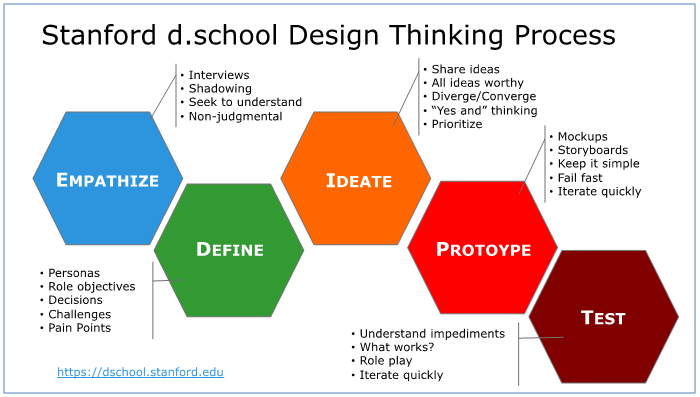
D.School Design Thinking was developed by the Institute of Design at Stanford University in the United States and offers another design process that can be followed while working on a design problem.

Source: https://www.theagileelephant.com/wp-content/uploads/2018/02/Design-Thinking.png (Last Accessed 06/02/23)
The D.School process is split into five sections and that are followed to develop a final solution.